A correlation coefficient is a statistical measure of the degree to which changes to the value of one variable predict change to the value of another.
Correlation coefficients are expressed as values between +1 and -1 .

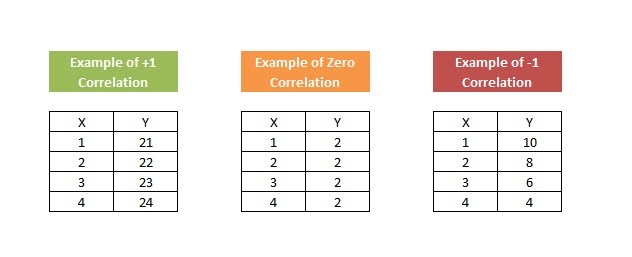 Positively correlated variables – value increases or decreases in tandem. A coefficient of +1 indicates a perfect Positive Correlation.
A cloud of points around SD line slopes Up.
- The more tightly clustered the points are along a line, the stronger the relationship between the variables, and the closer r is to 1.0.
- When the correlation is near 1.0, knowing a point’s X value allows you to predict its Y value with very little error.
- But that doesn’t mean that the Y value is the same or nearly the same as the X value, since the Y variable may be expressed in completely different units
Examples:
- Hours spent studying and grade point averages.
- Education and income levels.
- Poverty and crime levels.
Negatively correlated variables – value of one increases as the value of the other decreases. A coefficient of -1 indicates a perfect Negative Correlation.
A cloud of points around SD line slopes Down. As seen in above figure.
Examples:
- Commodity supply and demand.
- Pages printed and printer ink supply.
- Education and religiosity.
No Correlation: A coefficient of zero indicates there is no discernible relationship between fluctuations of the variables.
Computing r , How-to
r = average ( x in STD units * y in STD Units )
See post on Standard Units for more info.
The connection between r and the typical distance above or below the SD line is given by
√(2(1- |r|)) * Vertical SD
Example: if r = 0.95
√(2(1- 0.95)) , approx. 0.3.
So the spread around the SD line is about 30% of a vertical SD, when r = 0.95.
 Avinash.tech(...)