What are Mutual Funds ?
A mutual fund is a professionally managed investment fund that pools money from many investors to purchase securities. These investors may be retail or institutional in nature. Mutual funds have advantages and disadvantages compared to direct investing in individual securities. – Wikipedia
In simple terms a Mutual Fund tries to make an investor’s life easier by maintaining a portfolio based on his/her goals in life. All one needs to do is pay a little fee to manage them ( little is not always true ) considering the projected profits we are making ( projections are also fishy in most cases)
Regular versus Direct Mutual Funds
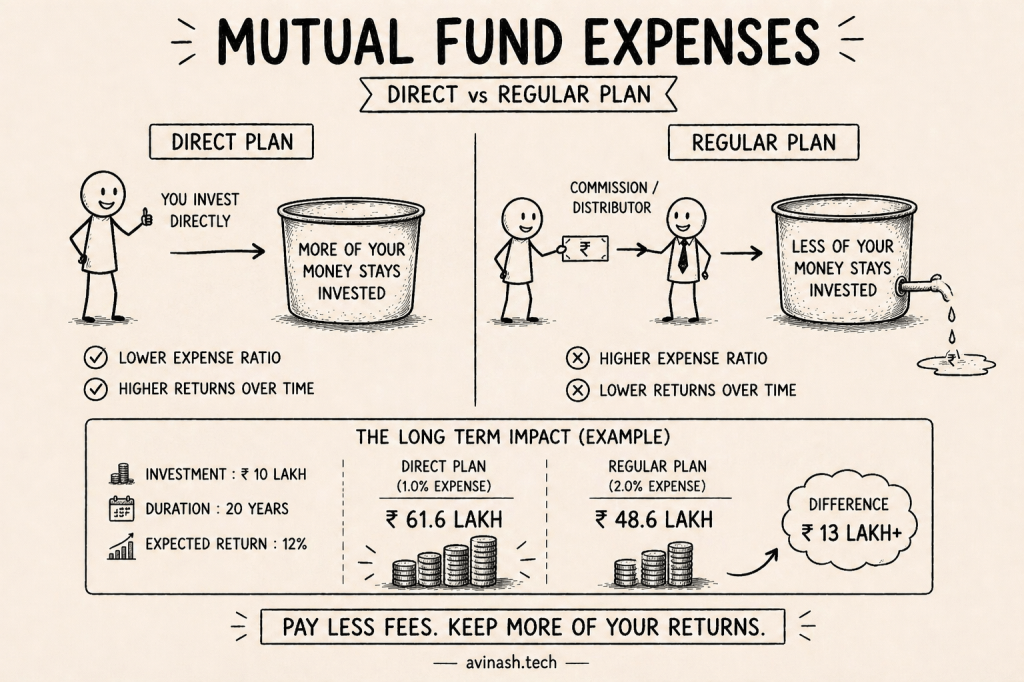
Regular MF – A commission is paid to your Investment Advisor by the Fund Houses ( example: UTI , HDFC etc )
Direct MF – No middleman ( Investment Advisor ) and one can directly buy from Fund houses at half the expense ratio.
What is an NAV ?
Net Asset Value is simple , take the current market value of the fund’s net assets (securities held by the fund minus any liabilities) and divide by the number of shares outstanding. Thus, if a fund has total net assets of 1000/- INR and there are 100 shares of the fund, then the NAV is 10 INR per share ( 1000 / 100 ).
- The NAV is used to determine the value of your holdings in the mutual fund (the number of shares held multiplied by the NAV price per share)
- The NAV is the price at which new shares are purchased or redeemed
Open vs Close-end Mutual Funds
Open-end funds : You invest your money in an open-end mutual fund by buying shares at the NAV. Open-end funds determine the market value of their assets at the end of each trading day.
Close-end funds: Closed-end funds issue a fixed number of shares that are traded on the stock exchanges or in the over-the-counter (OTC) market. Unlike open-end funds, however, closed-end funds do not trade at their NAVs. Instead, their share prices are based on the supply of and demand for their funds and other fundamental factors. The brokerage fees on these newly issued shares can be quite high, which then erodes the price of the shares when they trade on the market.
What about TAX ?
- 15% TAX on capital gain if sold within 1 year of purchase date
- 10% TAX on capital gain if sold after 1 year of purchase date
- Above taxation is fixed and independent of the TAX bracket one is in.
What is an expense Ratio ?
The expense ratio of a stock or asset fund is the total percentage of fund assets used for administrative, management, advertising , and all other expenses. An expense ratio of 1% per annum means that each year 1% of the fund’s total assets will be used to cover expenses. The expense ratio does not include sales loads or brokerage commissions.
Why Expense Ratio are pure evil ?
Note: Do your research before investing. Never trust someone to invest your hard earned money.
Please read the disclaimer carefully before making any investment based on the articles published on this Blog !!

 Avinash.tech(...)
One response to “Mutual Fund 101”
[…] would push you towards a Regular Mutual Fund which has twice the fee of a Direct Mutual Fund. ( See Mutual Fund 101 […]
LikeLike