What is an Expense ratio ?
The expense ratio of a stock or asset fund is the total percentage of fund assets used for administrative, management, advertising , and all other expenses. An expense ratio of 1% per annum means that each year 1% of the fund’s total assets will be used to cover expenses. The expense ratio does not include sales loads or brokerage commissions.
Lets see how an expense ratio of just 2% can eat up your returns. Consider a monthly investment of 20,000/- INR for a period of 20 years with 17% compounded returns.
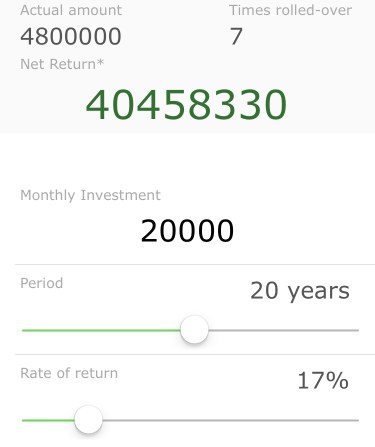
Investment grows to 4 Crores with the power of compounding !
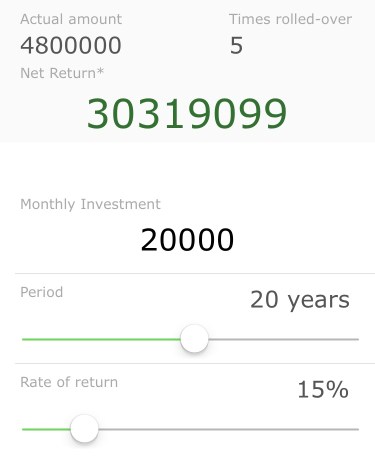
Investment down by 1 Crore due to an expense ratio of 2% !!!
For better understand, lets take an example of 3 friends, Arjun , Bheem and Chanakya. At age 25 they get together and decide to invest 1,00,000 INR in a Mutual Fund of choice. They soon realize each of their selected funds incur a fee of 3% , 2% and 0.2% respectively. They still go ahead with the investment and plan to get back to it after 30 years.
At age 55, all get together to see how their Mutual Funds have performed. Assuming each fund yielded same returns, the following results were observed.
- Arjun got a return of (10% – fees of 3% ) = 7,61,225.50
- Bheem got a return of (10% – fees of 2% ) = 10,06,265.69
- Chanakya got a return of (10% – fees of 0.2% ) = 16,52,228.86
Chanakya’s Fund was a clear winner beating Arjun’s fund comfortably by 2X.
Clearly fee does matter !!!
In the above scenario we took a hypothetical scenario were market gave us 10%, what if the market remained flat for 10+ years with an added fee of 3%?
We would be down 40% on our investment. Think about this, money is yours, risk is yours , profit? Ofcourse the Fund Manager’s. Isn’t this day light robbery  .
.
“By giving excessive fees, you are giving up 40% to 60% of your future nest egg”. – John C. Bogle , Creator of Vanguard
That would sometime amount to working 12 more years to achieve one’s financial freedom !!
What should one look for while selecting Mutual Funds ?
- Always pick Direct over Regular
- Always choose a Mutual Fund with least Expense Ratio
- Never go by past performance of a Mutual Fund. Nobody can predict the market. See my other posts for more info on why…
The best bet for a Know Nothing Investor ?
Invest in an Index Fund that matches the returns of a Market. Why ?
- Has the least expense ratio ( < 0.2 % ) .
- No Exit load ( Entry load recently banned by SEBI for all MF’s )
- Compounded Annual Growth Rate for Index Fund has been 12% to date. Way better than Fixed Deposit which give 7% + TAX.
- No/Least Operating cost.
- Investment horizon 15+ years. Slow and steady wins the race
Which Index Fund ?
Based on the discussion above
- UTI Nifty 50 Direct Growth meets all the requirements of a great Mutual Fund. It has an expense ratio of around 0.13% .
- If you want to diversify more UTI Nifty Next 50 Direct Growth can also be looked into. Read more
Note: Do your research before investing. Never trust someone to invest your hard earned money.
Please read the disclaimer carefully before making any investment based on the articles published on this Blog !!







4 responses to “Expense Ratio is pure evil !”
[…] Why Expense Ratio are pure evil ? […]
LikeLike
[…] If we are focused on Short-Term returns other Mutual Fund’s may perform better , but given the Fee and Tax implications even Short-Term Mutual funds have not been able to beat the Market […]
LikeLike
[…] can be good only when invested in a low fee passively managed Fund. Read more about Index Fund, Expense Ratio , Index Fund Sahi hai – Part1 and […]
LikeLike
[…] not get carried away and assume we will get 12% over the next 20 years. Read more about Index Fund, Expense Ratio , Index Fund Sahi hai – Part1 and […]
LikeLike