Introduction
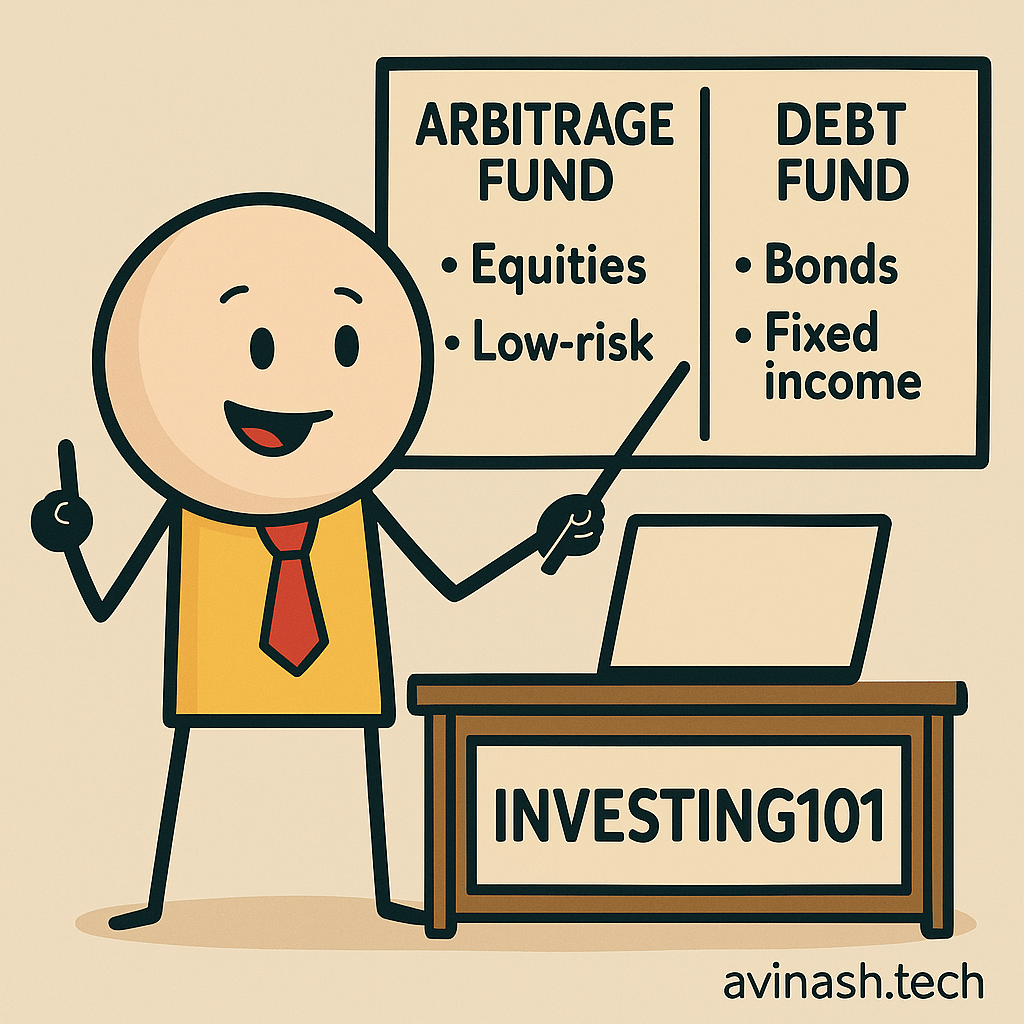
For investors in the 30% tax bracket, every percentage point matters when it comes to net returns. While debt funds have been a traditional choice for conservative investors, arbitrage funds offer a potentially more tax-efficient alternative. This article delves into whether investing in arbitrage funds makes financial sense compared to debt funds, especially when considering expense ratios and tax implications.
Understanding Arbitrage and Debt Funds
Arbitrage Funds
- Definition: Mutual funds that exploit price differences of the same asset in different markets or forms.
- Objective: Generate low-risk returns through simultaneous buying and selling of securities in different markets.
- Risk Profile: Generally low-risk due to hedging strategies.
Debt Funds
- Definition: Mutual funds that invest in fixed-income instruments like government bonds, corporate bonds, and money market instruments.
- Objective: Provide steady and regular income with relatively lower risk compared to equity funds.
- Risk Profile: Subject to interest rate risk and credit risk.
Expense Ratios: The Cost of Investing
Expense Ratio is the annual fee charged by mutual funds to manage your investment.
- Arbitrage Funds: Typically range from 0.30% to 1.00%.
- Debt Funds: Generally range from 0.10% to 0.75%.
Impact: A higher expense ratio can eat into your returns, but it might be offset by tax savings.
Taxation: The Game Changer
Arbitrage Funds Taxation
- Short-Term Capital Gains (STCG): Holdings < 12 months taxed at 15%.
- Long-Term Capital Gains (LTCG): Holdings ≥ 12 months taxed at 12.5% on gains exceeding ₹1.25 lakh per financial year.
Debt Funds Taxation
- Short-Term Capital Gains (STCG): Holdings < 36 months taxed at your income tax slab rate (30% in this case).
- Long-Term Capital Gains (LTCG): Holdings ≥ 36 months taxed at 20% with indexation benefits.
Breakeven Analysis: When Does Arbitrage Win Over Debt?
Assumptions for Calculation
- Investment Amount: ₹10,00,000
- Annual Return Rate: 6% for both funds
- Expense Ratios:
- Arbitrage Fund: 0.75%
- Debt Fund: 0.50%
- Holding Period: 1 year
Calculating Net Returns
Debt Fund
- Gross Returns: ₹10,00,000 × 6% = ₹60,000
- Expense Ratio Cost: ₹10,00,000 × 0.50% = ₹5,000
- Net Returns Before Tax: ₹60,000 – ₹5,000 = ₹55,000
- Tax on Gains: ₹55,000 × 30% = ₹16,500
- Net Returns After Tax: ₹55,000 – ₹16,500 = ₹38,500
Arbitrage Fund
- Gross Returns: ₹10,00,000 × 6% = ₹60,000
- Expense Ratio Cost: ₹10,00,000 × 0.75% = ₹7,500
- Net Returns Before Tax: ₹60,000 – ₹7,500 = ₹52,500
- Tax on Gains: ₹52,500 × 15% = ₹7,875
- Net Returns After Tax: ₹52,500 – ₹7,875 = ₹44,625
Net Gain Comparison
- Arbitrage Fund Net Returns: ₹44,625
- Debt Fund Net Returns: ₹38,500
- Difference: ₹6,125 in favor of arbitrage funds.
Conclusion: Despite a higher expense ratio, arbitrage funds provide higher net returns due to significant tax savings.
Why Investment Amount Doesn’t Affect the Outcome
The calculations are proportional. Whether you invest ₹1 lakh or ₹50 lakhs, the percentage differences remain consistent:
- Additional Expense in Arbitrage Funds: Scales with investment.
- Tax Savings: Also scales with investment and outweighs the additional expense.
When Debt Funds Might Be Preferable
- Long-Term Horizon: Holding period of more than 3 years.
- Indexation Benefits: For long-term capital gains, indexation can significantly reduce taxable gains.
- Risk Considerations: Debt funds might offer more predictable returns in certain market conditions.
Key Factors to Consider
Tax Efficiency
- Arbitrage Funds: More tax-efficient for short-term investments (< 3 years) in the 30% tax bracket.
- Debt Funds: Potentially more efficient for long-term investments due to indexation.
Expense Ratios
- Higher expense ratios in arbitrage funds are often offset by tax savings.
- Always compare net returns after accounting for both expenses and taxes.
Investment Horizon
- Short-Term (≤ 3 years): Arbitrage funds are generally more advantageous.
- Long-Term (> 3 years): Debt funds might offer better net returns due to indexation.
Risk Profile
- Arbitrage Funds: Low-risk but dependent on market volatility for opportunities.
- Debt Funds: Subject to interest rate and credit risks.
Practical Tips for Investors
- Assess Your Goals: Align your choice with your financial objectives and investment horizon.
- Consult a Financial Advisor: Personalized advice can help tailor investments to your specific situation.
- Diversify: Consider allocating funds to both types to balance risk and returns.
- Stay Informed: Keep abreast of tax laws and market conditions that may affect your investments.
Conclusion
For investors in the 30% tax slab with a short to medium-term investment horizon, arbitrage funds offer a compelling advantage over debt funds due to their favorable tax treatment. While the higher expense ratio might seem like a drawback, the significant tax savings typically result in higher net returns. However, it’s essential to consider all factors, including risk tolerance and investment goals, before making a decision.
Additional Resources
Disclaimer: This article is for informational purposes only and should not be considered financial advice. Consult with a certified financial advisor before making any investment decisions.
 Avinash.tech(...)
One response to “Arbitrage Funds vs. Debt Funds: A Tax-Efficient Investment Strategy for the 30% Tax Slab”
well explained!
LikeLike