
Dwarka – Krishna’s Sacred City Lost to the Sea
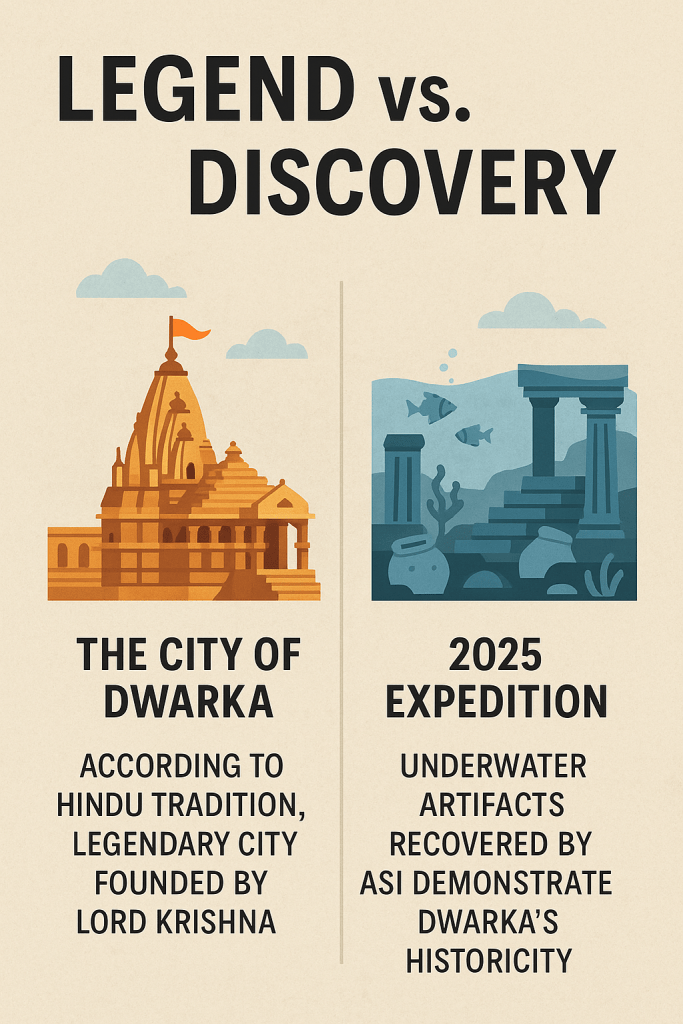
Dwarka, the legendary city of Lord Krishna, has captivated Indian imagination for millennia. Ancient texts describe Dwarka as a golden metropolis founded by Krishna on India’s western coast, filled with opulent palaces and bustling harbors . According to the Mahabharata, this city boasted 900,000 palaces of crystal and silver, adorned with emeralds, and was masterfully planned into sectors with residential quarters, grand roads, gardens, and lakes . In lore, Dwarka met a tragic fate – submerged into the sea after Krishna’s era, around 9,000 years ago . For generations, Indians cherished Dwarka as one of the char dham pilgrimage sites, even as modern historians dismissed these accounts as mere myth. Today, that is changing. Recent archaeological expeditions are uncovering stunning evidence that Krishna’s Dwarka was real – and far older than anyone imagined.
The 2025 ASI Underwater Expedition – Unearthing the Truth
In 2025, the Archaeological Survey of India’s Underwater Archaeology Wing (UAW) launched a historic expedition to probe the sunken ruins off Dwarka’s coast . Led by Prof. Alok Tripathi, with a team notably including three women archaeologists, the project represents a renewed commitment to uncover India’s submerged heritage . Their diving teams focused on the waters near the Gomati Creek, where earlier sonar scans and low-tide explorations hinted at structures beneath the waves . The findings so far are nothing short of extraordinary:
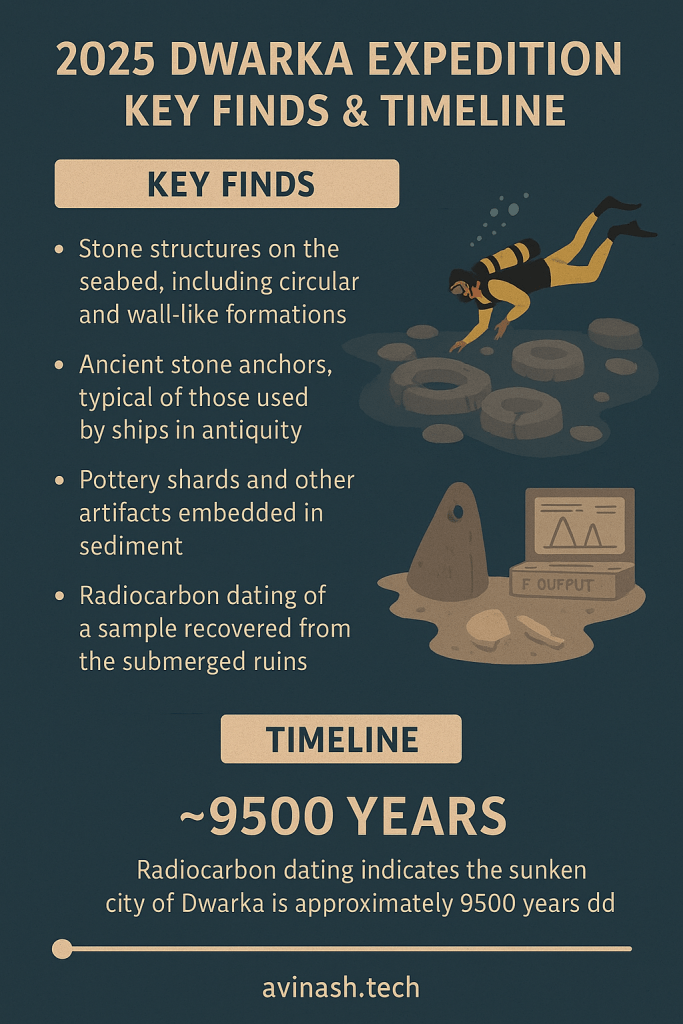
Stone Structures on the Seabed: The team discovered circular stone formations and long wall-like features on the ocean floor, arranged in geometric layouts. These resemble foundation walls and building bases spread across a vast area, suggestive of an urban settlement . The layout even hints at a planned city – eerily echoing the Mahabharata’s description of Dwarka’s well-organized sectors and blocks. Divers marked and mapped these structures meticulously, some lying 36 meters (120 ft) underwater. Ancient Stone Anchors: Scattered around the structures, the expedition identified multiple massive stone anchors carved from rock. These were typically triangular or cylindrical with holes – the type used by ships in antiquity . Their presence signals that Dwarka was once a busy port where vessels moored. In fact, past ASI excavations between 2005–07 had also unearthed stone anchors on shore, validating that this spot was an active harbor in ancient times . It appears the legendary “Gateway to Heaven” was a maritime gateway as well, with maritime activity flourishing on Krishna’s coastline. Pottery and Artifacts: The underwater team retrieved pottery shards and other artifacts embedded in sediment. Earthenware pieces – potsherds, beads, and fragments of stone utensils – have emerged encrusted in coral. Preliminary analysis indicates these items are very old and handcrafted, possibly using techniques seen in early Harappan culture. Similar finds in a prior offshore survey included construction materials, beads, sculpture fragments and even human bones and teeth, all preserved under layers of sand . Such cultural material provides a glimpse of everyday life in Dwarka’s heyday – from the pottery that held oil or grain, to the anchors that tethered ships bearing goods and pilgrims. Carbon Dating ~9500 Years: The most astounding result came from scientific dating of recovered samples. A carbonized wooden piece found amid the ruins was sent to a laboratory in Hannover, Germany for radiocarbon dating . The German lab’s analysis dated the sample to roughly 9,500 years before present . In other words, this sunken city likely thrived around 7500 BCE. For context, that age predates the Harappan (Indus Valley) civilization by millennia and is older than the earliest Mesopotamian or Egyptian cities by thousands of years . Multiple tests confirmed this stunning antiquity – one dated a piece of debris to ~9,545 years old, aligning with another lab’s result of ~9,580 years .
The conclusion: Dwarka’s submerged ruins could be among the oldest known urban settlements on the planet, dramatically extending the timeline of Indian civilization .
Dwarka’s Age: Rewriting the Timeline of Civilization
These discoveries in Dwarka’s bay have sent shockwaves through the historical community. A sunken city around 9,500 years old forces us to rethink the very timeline of civilization. Until recently, mainstream historians taught that the earliest cities arose in Mesopotamia around 4000 BCE, and that Indian civilization began with the Indus Valley (~2500 BCE) or later. But Dwarka’s 9500-year-old ruins shatter that chronology . If corroborated, this means an advanced city existed on India’s west coast when most of the world was still in prehistory. The site shows signs of town-planning – grid-like layouts, possible drainage or canal structures, and a harbor – implying organized urban life . Such sophistication in 7500 BCE is almost unfathomable. It suggests that the ancestors of today’s Indians were building towns thousands of years before the Egyptian pyramids or Chinese civilization emerged .
The Dwarka excavations thus bridge mythology and history. The ancient texts spoke of a city swallowed by the sea at the end of the Dwapara Yuga – long before recorded history. Academics long laughed off that timeline. Now, science is validating it. Radiocarbon and thermoluminescence dates from underwater artifacts have consistently yielded extreme antiquity – not only the ~9500 YBP (years before present) wooden sample, but even a piece of pottery from the Gulf of Cambay waters that astonishingly dated to 13,000+ years ago . In one case, an ill-fired pot shard was dated by Oxford University to ~16,800 years before present , possibly making it the oldest known pottery in the world. While those dates require further verification, they underscore a revolutionary point: Indian civilization may be far older than conventionally thought, potentially the “cradle of civilization” itself .
For India, these findings are more than just an archaeological curiosity – they are a civilizational reaffirmation. The ruins of Dwarka are concrete proof that the subcontinent’s urban culture predates what we were taught in history class. They vindicate the traditional lore that our ancestors built magnificent cities in hoary antiquity. As Murli Manohar Joshi (India’s Science & Technology minister in 2001) declared when initial Gulf of Cambay results came out, these artifacts offer “proof of a civilization older than the Bronze Age Indus Valley” . In short, Dwarka is not a myth – it is our history. And its true age compels historians worldwide to rewrite the global timeline with Bharat back in focus.
Colonial Historians and the ‘Mythology’ Narrative
Why is the discovery of Dwarka’s antiquity so significant beyond archaeology? Because it directly challenges a narrative imposed during the British colonial era – a narrative that systematically dismissed Indian history as mere mythology. Starting in the 1800s, British administrators and scholars often portrayed India’s ancient epics and traditions as exaggerated fables, unworthy of serious history. They claimed that Indians lacked any sense of history and that texts like the Mahabharata and Ramayana were pure myths, not records of real events or people.
This dismissive attitude was not an accident; it was a deliberate colonial policy. Influential figures like Thomas Babington Macaulay helped enforce it through the education system. In his infamous Minute on Indian Education (1835), Macaulay was scathingly derisive of Indian culture and literature. He openly stated that “a single shelf of a good European library was worth the whole native literature of India and Arabia.” Such was his contempt for India’s epics, philosophy, and sciences that he sought to replace them entirely with Western learning. Macaulay envisioned creating “a class of persons, Indian in blood and colour, but English in taste, in opinions, in morals, and in intellect.” To achieve this, the British rewrote curricula to marginalize Sanskrit, Persian, and traditional knowledge, and to teach Indians only the European version of history . Generations of Indian students learned that their own civilizational heritage was primitive or mythical, while Western civilization was portrayed as the pinnacle of progress.
Colonial historians in the 19th century took great pains to erase or trivialize India’s ancient timeline. They refused to accept Indian records that dated events thousands of years in the past. For example, early Indologists, influenced by Biblical chronology, were reluctant to date Indian texts or history earlier than 2500 B.C. – roughly the date of the Old Testament flood – lest it contradict the Bible . As one scholar notes, these Indologists “relegated all the Vedic texts and the personalities found in them to the realm of mythology.” The sages and heroes of India were dismissed as fictitious, their grand epochs compressed or denied. British historians arbitrarily pegged the composition of the Vedas to around 1200–1500 BCE (with no solid evidence), and declared that “ancient India” began only after Alexander’s invasion or the Mauryan Empire. Everything before that – be it the Mahabharata war (traditionally ~3100 BCE), Lord Rama’s era, or cities like Dwarka – was consigned to myth. Through theories like the Aryan Invasion (which claimed civilization was brought to India by outsiders around 1500 BCE), colonial scholars further denied indigenous antiquity . The net effect was a Eurocentric timeline in which India’s contributions were late and derivative.
This condescending view wasn’t limited to academic circles – it was engrained in governance. The British educational apparatus consciously weeded out the Indian perspective of time. Macaulay’s 1835 Minute became policy within a month , resulting in the English Education Act of 1835. Funds for traditional Indian learning were slashed, and English-medium schools teaching European history and science sprang up . Sanskrit colleges were de-funded. The Puranic timelines, which speak of Indian kings reigning thousands of years ago, were labeled absurd. For colonial officers, Indian chronology was something to either ignore or “fix” – and fix it they did, to a much shorter span that comfortably placed Western civilization at the forefront.
Reclaiming Our History – Why Dwarka Matters Today
The underwater discovery of Dwarka is more than an archaeological triumph – it is a cultural and intellectual emancipation. It symbolizes India reclaiming its history from those who doubted it. When structures and artifacts from a 9500-year-old city are pulled from the Arabian Sea, the old colonial scoffs of “myth” fall silent. No longer can anyone argue that India’s ancient epics are pure fantasy devoid of historical basis. Dwarka’s ruins corroborate literary tradition : the archaeology matches descriptions in our scriptures, from submerged city walls to stone anchors that once secured ships described in the Mahabharata. As a report in The New Indian Express noted, these finds predate the oldest known remains in the subcontinent by over 5,000 years , meaning India’s ancient cities were thriving well before Mesopotamia or Egypt. The pride that modern Indians feel in this validation is palpable – a sense that at last, the world is recognizing the depth of our civilization.
Crucially, the significance of Dwarka’s discovery lies in undoing centuries of narrative damage. Colonialism didn’t just impoverish India’s economy; it tried to impoverish our history and self-image. By repeatedly calling our heritage a “myth”, the colonizers planted seeds of doubt that linger even today. Many of us grew up reading history textbooks that gave only a passing mention to Vedic or epic ages, as if nothing of importance happened in India before Buddha or the Mauryas. We were subtly taught to be skeptical of our own puranas and itihasa, to assume that our ancestors were primitive compared to Greeks or Romans. But now the tables are turning. Discoveries like Dwarka empower Indians to reconnect with a glorious past on their own terms. They validate what our rishis and grandmothers have passed down – that this land saw enlightened cities and mighty kingdoms when other cultures were newborn.
The tone of discourse is shifting from disbelief to wonder and respect. Even scientists approach sites like Dwarka with an open mind, armed with technology (sonar mapping, sub-bottom profiling, ROV cameras) to let evidence speak louder than prejudice. And the evidence is indeed speaking: it tells of a very old, sophisticated coastal city that fits the profile of Krishna’s capital. As one marine archaeologist observed, the “archaeological evidence correlates with descriptions given in [the epic] literature.” What was once thought to be legend is literally materializing from the seabed.
Embracing India’s Ancient Civilization – A Call to Action
Dwarka’s saga is a clarion call for all Indians – and lovers of history worldwide – to preserve, study, and take pride in our ancient civilization. We stand at a juncture where science is finally catching up with lore, providing us an opportunity to rewrite history accurately and with justice. This is a national awakening of sorts, where we no longer need to measure ourselves by Western timelines. Instead, we contribute new chapters to human history books, proudly and factually.
Moving forward, it is vital that we support archaeological research across India’s countless ancient sites – not just Dwarka, but Hastinapura, Ayodhya, Kishkindha, and beyond. The government and scholarly institutions should invest in underwater archaeology, satellite remote sensing, and advanced dating techniques. Each discovery – a buried temple, a lost river course, an ancient manuscript – is a piece of the grand puzzle of Indian heritage waiting to be put back in place. We must also update our educational curricula to include these new findings, so that our children learn a balanced history that celebrates indigenous achievements. No child in India should finish school still thinking that our history is “only myth” or that we lagged behind – the truth is quite the opposite, as Dwarka proves.
Finally, as citizens, we should take pride, not in a chauvinistic way, but in a rejuvenating way. To take pride is to feel responsible for protecting our heritage. The structures underwater at Dwarka survived 9,000 years of tides and currents – surely we can ensure that in the next 9,000 years, their story is not forgotten again. Let us be the generation that reclaims our narrative: honoring the ancients by scientifically validating their stories, and in doing so, inspiring a resurgence of Indian civilizational confidence. Dwarka rising from the depths is more than an archaeological event – it is India rising from the shadows of colonially imposed doubt, to stand tall, anchored in truth like the stone anchors of her once-great port.
Jai Hind! (Let us preserve and celebrate the eternal heritage of this land.)
 Avinash.tech(...)