The Next Shift in AI: From GPUs to Hardwired Intelligence
For years, the story of artificial intelligence has been simple: bigger models + more GPUs = better intelligence.
That formula gave us ChatGPT, Claude, and Gemini. It also created an industry powered by massive data centers, expensive hardware, and ever-growing energy demands. But beneath the surface, something is breaking. AI is running into fundamental limits—not of intelligence, but of efficiency.
A new wave of ideas—combining hardwired AI chips and extreme compression techniques like TurboQuant—is pointing toward a very different future.
The Problem: AI Is Hitting a Wall

Modern AI systems are incredibly powerful—but deeply inefficient. Most people assume AI is limited by compute. In reality, the bigger constraint is memory. Language models don’t just store parameters. They also maintain a KV cache—a growing working memory that expands with every token in a conversation.
At scale, this becomes a serious issue:
The memory required to run AI can exceed the memory required to store it.
This leads to:
- Constant data movement between memory and compute
- Increased latency
- High energy consumption
- Exploding infrastructure costs
GPUs manage this through brute force. But they were never designed specifically for AI—they are general-purpose systems solving a specialized problem.
And that mismatch is starting to show.
The First Shift: Turning Models Into Hardware
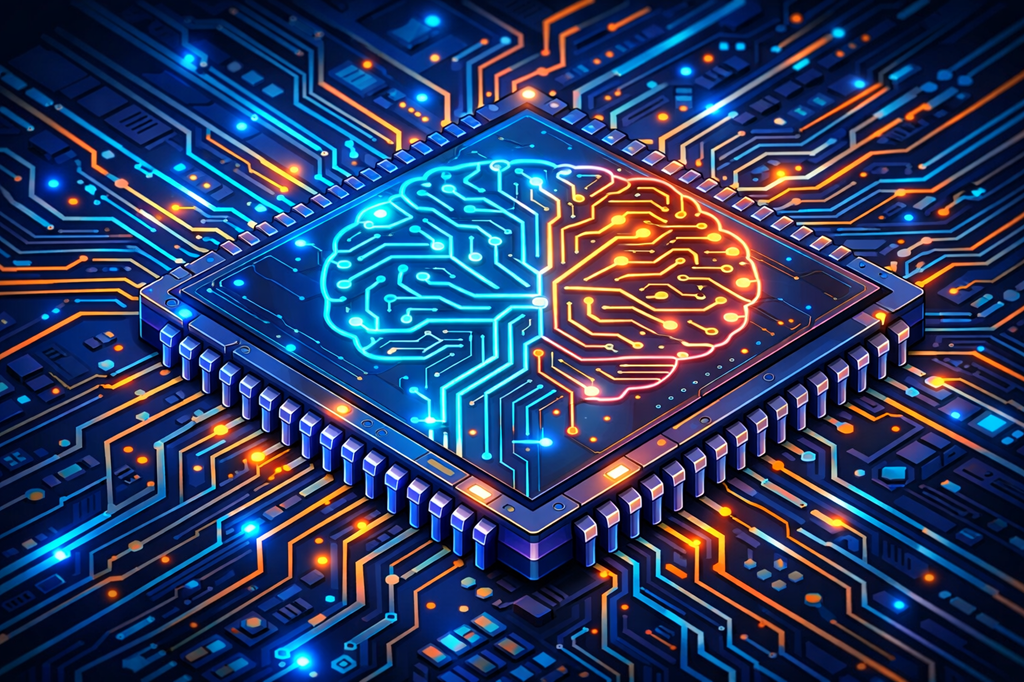
What if we flipped the paradigm?
Instead of running AI as software on hardware…
What if the model itself became the hardware?
This is the idea behind emerging chips like the Taalas HC1.Here, the model’s weights are embedded directly into silicon. Compute and memory are tightly integrated. The system is no longer general-purpose—it is purpose-built for one neural network.
The result is dramatic:
- Orders-of-magnitude faster inference
- Near-instant responses
- Significant energy efficiency
This works because it eliminates one of the biggest inefficiencies in modern AI: data movement.
But there’s a trade-off. These systems sacrifice flexibility:
- Models can’t be easily updated
- Architectures are fixed
- Adaptability is limited
They solve compute inefficiency—but not everything.
The Second Shift: Compressing Intelligence

If the first shift removes compute inefficiency, the second tackles something even more fundamental:
The cost of memory.
Google’s TurboQuant introduces a breakthrough in how AI systems handle their working memory. It compresses the KV cache—the growing memory used during conversations—by up to 6×, while also accelerating attention computation.
And it does this:
- Without retraining models
- Without degrading performance
This is crucial because the KV cache is one of the fastest-growing constraints in real-world deployments.
By shrinking it, TurboQuant:
- Reduces memory requirements
- Improves latency
- Lowers infrastructure cost
Individually, this is powerful. But combined with specialized hardware, it becomes transformative.
The Future: AI as Specialized Infrastructure

The real breakthrough isn’t just hardware or compression—it’s the combination of both.
- Hardwired chips remove compute inefficiency
- Compression techniques remove memory inefficiency
Together, they eliminate the two biggest bottlenecks in AI. This leads to a new kind of AI stack:
- Training remains flexible and compute-heavy
- Frontier models run on high-performance systems
- Deployment shifts toward specialized, efficient hardware
Over time, this enables:
- Faster, cheaper AI at scale
- Real-time intelligent systems
- More accessible and energy-efficient deployments
The future of AI is not about one piece of technology replacing another.
It’s about a transition from:
General-purpose computing
To:
Specialized intelligence systems designed for efficiency
Final Thought
The next phase of AI won’t be defined by who builds the biggest model. It will be defined by who builds the most efficient system. Because the future of AI is not just smarter—it’s leaner, faster, and deeply integrated with the hardware it runs on.
 Avinash.tech(...)
Leave a comment